Just a quick heads up – some of the links I share on this site are affiliate links. That means if you click on one and make a purchase, I may earn a small commission at no extra cost to you. Your support through these links helps me create valuable content.
The sea around Malta is warm. In July and August, it often reaches 29‑30 °C, so you can stay in the water for hours. I’ve lived here since 2011 and swim almost every summer week. I began bringing my snorkelling mask not for a dedicated snorkelling outing but because it makes a swim more interesting; you see fish and sometimes something unexpected.

Written by Laura Jasenaite, Malta travel expert with 15+ years living on the islands.
This guide covers 14 snorkelling spots across Malta, Gozo and Comino, with honest notes on what you will actually find at each one. If you are still planning the rest of your trip, start with my first-timer’s guide to the best things to do in Malta and see water sports in Malta for other ways to get in the sea.
Last reviewed: September 2026.
Quick answers
- Is snorkelling in Malta worth it? Yes. The water is clear, with visibility usually 20–30 metres and up to about 40 in the best conditions, and you can snorkel from almost any rocky beach.
- Best beginner spots: Imġiebah, Għajn Tuffieħa and Ramla (Gozo), plus Għasri Valley on Gozo. All are shallow or sheltered.
- Do I need a boat or a guide? No. Most spots are reachable on foot, and you can snorkel almost anywhere except in harbours.
- Do I need a wetsuit? Not for most of the year. The sea is coldest in March, around 15 °C, and reaches about 30 °C by August.
- Safety: snorkel with a buddy, tow a buoy, stay near the shore and watch for boats.
Don’t have time to plan every detail?
I’ve already done it for you. Get my complete 7-day Malta itinerary with routes, timings, and local tips included, so you can enjoy the islands stress-free.
Get the guideIs snorkelling in Malta worth it?
Malta makes a solid snorkelling spot. The water is clear, with visibility usually 20–30 metres and up to about 40 metres in the best conditions. You can snorkel along most of the rocky coast – just avoid the harbours – and you don’t need a boat or a guide. In July and August the sea is typically 29–30 °C, so a wetsuit isn’t required for most of the season.
The marine life is decent – sea bass, octopus, moray eels and the occasional ray. What really draws you is how easy it is to get in. Slip on a mask, and you’re underwater within minutes of reaching almost any rocky beach. I’m not sure it’s dramatically different from other Mediterranean spots, but it’s consistently good and very easy to do on your own.
What marine life can you see snorkelling in Malta?
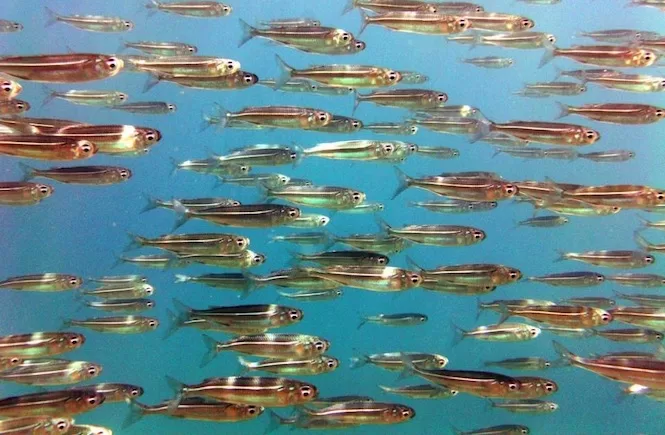
Along Malta’s rocky coast you’ll most often see sea bass, octopus, moray eels, groupers, crabs and a range of reef fish. In sandy bays you might spot stingrays on the seabed and, on occasion, flying fish.
Octopus are especially worth watching. They’re most active in the morning, often visible in the shallows. Because they match the colour and texture of the rocks, they’re easy to miss – almost like chameleons. Once you know what to look for, you’ll start seeing them regularly.
I once saw a turtle while swimming in Sliema and was surprised to find it so close to shore. I tried to follow, but it was far quicker than me.
Malta’s waters also host barracuda, snappers, shrimp, lobsters, sponges and sea caves where species that avoid open water tend to gather. In most summers, there are jellyfish; see my jellyfish in Malta guide.
Best snorkelling spots in Malta
Get a FREE Attractions Map
Planning a trip to Malta, Gozo, or Comino? Get this free interactive map filled with insider tips, Google Maps links, and more.
I want it!Wherever you go in Malta, bring your snorkelling mask. If the beach has a rocky coastline, swim along the rocks rather than staying on the sand. Most of the spots below are reachable on foot, so no boat is needed.
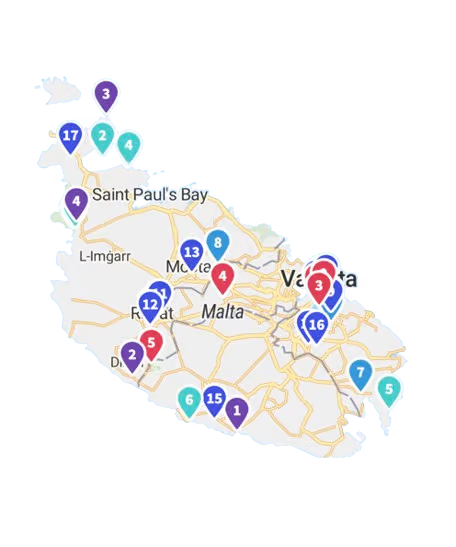
I’ve highlighted beginner‑friendly options throughout. The map below shows all 14 locations:
- Blue pins are Malta (1–7)
- Orange pins are Comino (1–3)
- Green pins are Gozo (1–4).
| Spot | Island | Conditions | Beginner-friendly? |
|---|---|---|---|
| Għajn Tuffieħa | Malta | 2–4 m, along the rocky edges | Yes |
| Blue Grotto | Malta | Deep water, boats and currents | No |
| Munxar Window | Malta | A few hundred metres of swimming, calm water only | No |
| Exiles Beach, Sliema | Malta | Rocky city beach, head to the open sea | No |
| Għar Lapsi | Malta | Shallow natural pool (closed in 2026) | Yes, when open |
| Paradise Bay | Malta | Shallow entry, snorkel the rocky sides | Yes |
| Imġiebah | Malta | Shallow, protected from currents | Yes |
| Blue Lagoon | Comino | Calm and clear, crowded, daily visitor limits | No |
| Santa Marija Cave | Comino | Calm sea only | No |
| Crystal Lagoon Cave | Comino | Long, dark cave, small boats go in | No |
| Ramla Beach | Gozo | Shallow, rocks on both sides | Yes |
| Għasri Valley | Gozo | Gets deeper gradually | Yes |
| Xwejni Bay | Gozo | Very shallow and rocky, wear aqua shoes | No |
| Blue Hole and Coral Gardens | Gozo | Deep water, never swim out from the Blue Hole | No |
Malta (blue pins 1–7)
1. Ghajn Tuffieha Beach (also called Riviera)
Stick to the rocky edges of the beach rather than heading straight out to sea. You might see sea bass, crabs and octopus. Over the sandy bottom, keep an eye out for stingrays. The water is about 2–4 metres deep, making it a solid beginner spot on the main island. My Ghajn Tuffieha guide includes directions and tips for the beach. Golden Bay is next door; see my Golden Bay guide.
2. Blue Grotto
The water is deep blue. You can swim along the colourful walls and see fish. Watch for boats in the caves and note that there can be currents. It isn’t suitable for beginners. My Blue Grotto guide provides the full picture for visiting the area.
3. Munxar Window
A secluded bay near Marsaskala lets you swim through a natural limestone arch when the water is calm. Marine life lines the walls, but you need to swim a few hundred metres from the entry point to reach the arch, so it isn’t a beginner spot.
If you prefer not to swim the distance, you could kayak to the area; there’s a kayak rental place in St Thomas Bay. More in my kayaking in Malta guide. You can also join a one-hour kayak trip from Marsaskala: Ultimate Kayak Adventure.
4. Exiles Beach, Sliema
This is my local spot; I live nearby and swim here often. It’s a rocky city beach, which might sound unappealing, but the rock formations in the water are genuinely interesting. Groups of sea bass are common, and I once came face‑to‑face with a turtle there. The bay beside Independence Gardens is murkier and offers less to see, so head towards the open sea instead. More swimming spots in my Sliema beaches guide.
5. Ghar Lapsi
On the west side of the island, there’s a natural swimming pool that’s mainly used by locals. The water is shallow and crystal‑clear, and you can swim out to deeper water where there are more fish. It’s one of the best beginner spots on the main island. See my Ghar Lapsi guide.
Unfortunately, it is closed for the 2026 season after an early‑year storm damaged the base; repairs are under way, and the site should reopen in 2027, so check before you plan a trip.
6. Paradise Bay Beach
A sandy beach where the snorkelling is along the rocky sides. The shallow entry makes it safe and manageable for first-timers. Accessible from Mellieha. See my Paradise Bay guide.
7. Imgiebah Beach
My favourite snorkelling spot on the main island is a sandy beach with a rocky coastline to explore, set in shallow, protected water. It’s suitable for both beginners and experienced snorkellers. Parking is ample and free. The access road is narrow, so if you’re not a confident driver, you might prefer to park and walk a short way to the beach. Full directions are in my Imgiebah Beach guide.
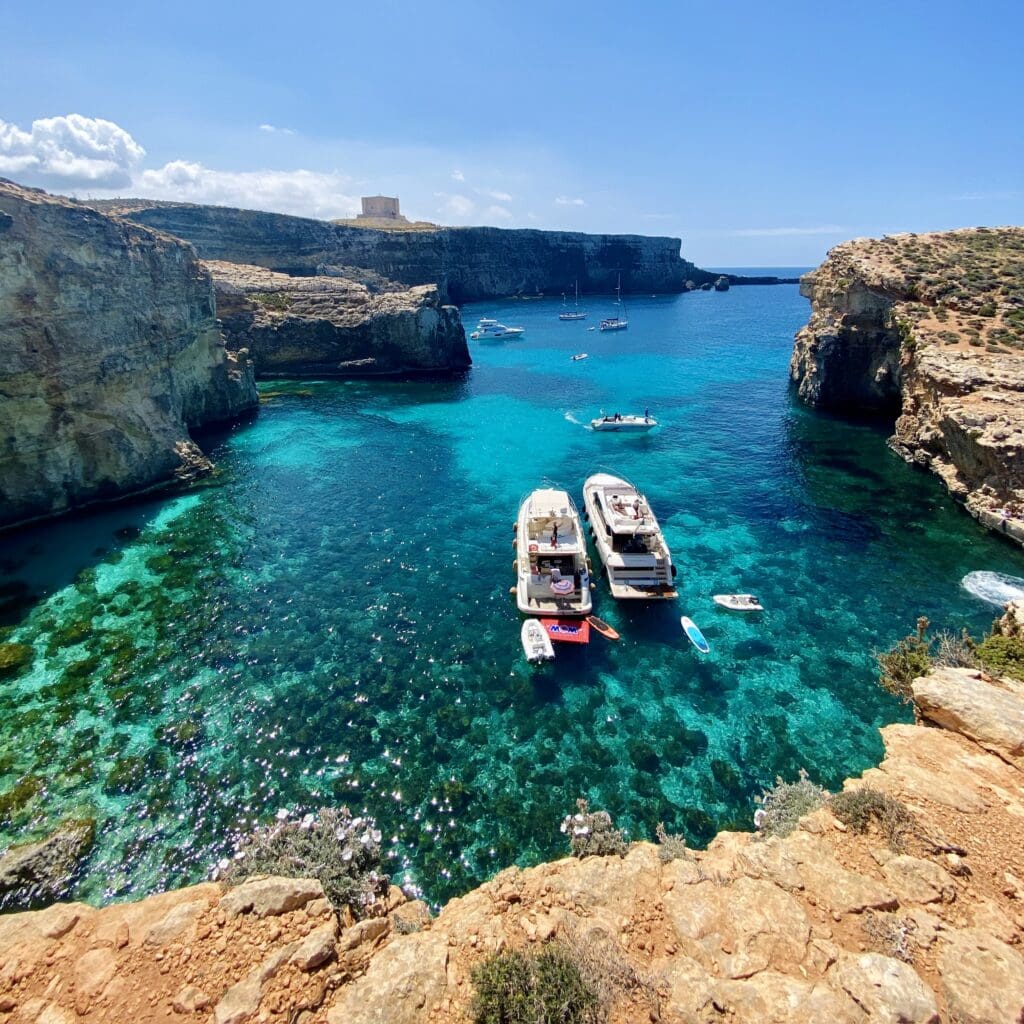
Comino (orange pins 1–3)
1. Blue Lagoon
The water is calm and clear, almost like a pool, and you’ll see plenty of marine life if you explore the rocky areas. It can be crowded, both on the beach and with boats in the water, so keep an eye out for vessels while you swim.
There are daily visitor limits: you get a wristband, and they count how many people enter. The limits are fairly high, and I’ve never heard of anyone being turned away, but it’s worth knowing. See my Blue Lagoon and Comino guide for how to get there. If you would rather not organise the boat yourself, this Blue Lagoon, Crystal Lagoon and sea caves boat tour visits the Blue Lagoon and Crystal Lagoon and the sea caves.
2. Santa Marija Cave
On the north-west side of Comino and hard to find, so use the map above. It has a natural swimming pool with two openings to the sea, and a ladder leads down to the water so you can swim on to other caves. You can go in, but only when the sea is calm, so check conditions first.
3. Crystal Lagoon Cave
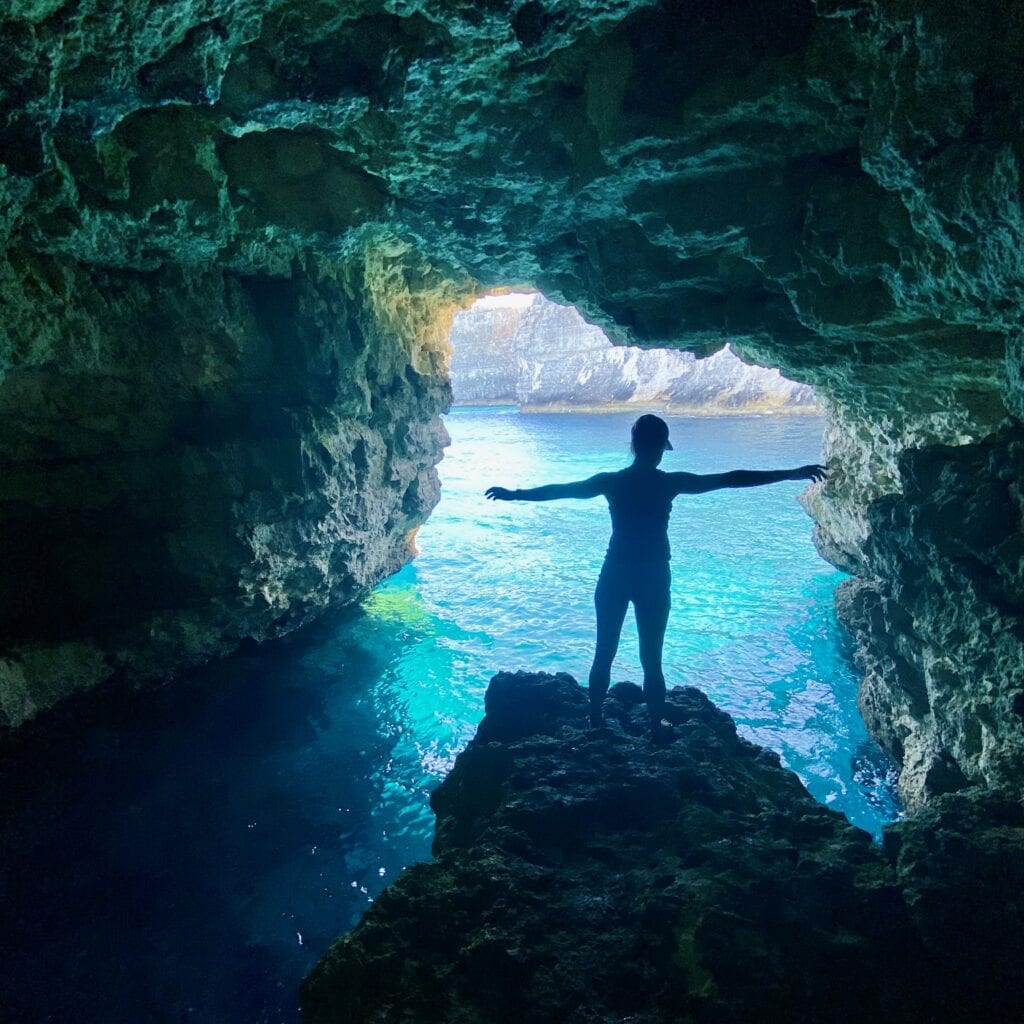
Boat tours to Comino stop at Crystal Lagoon. In the middle of the bay is a long cave. Small boats go inside, so swim close to the wall. I have swum in here many times. It is quite dark because the cave is so long, but it gets shallow at the end with a sandy bottom, like a small beach. It is one of my favourite places on Comino.
Gozo (green pins 1–4)
1. Ramla Beach
Swim along the rocks on either side of the beach, and you will see sea bass, moray eels, crabs and more. I love exploring both sides. The water is shallow, so first-timers can enjoy it too. See my Ramla Beach guide.
2. Ghasri Valley
A small canyon-like inlet with a secluded pebble beach and a narrow bay that opens to the sea. Swim along the walls and you will see plenty of marine life. It gets deeper gradually, so it suits beginners.
3. Xwejni Bay
A very shallow bay with a rocky bottom, so wear aqua shoes. Keep to your right and swim towards Xwejni rock, which you can see from everywhere. You will find underwater tunnels and other rock formations. If I had to pick two favourite spots on Gozo, this would be one.
4. Blue Hole and Coral Gardens (Dwejra)
The Blue Hole is a limestone sinkhole reached on foot, and one of my favourite snorkelling spots. You can see the opening to the sea, with deep blue water behind it and groups of fish, sometimes even tuna. Do not swim out to sea from the Blue Hole; it is dangerous. If you want open deep water, enter from the shore instead and keep left to reach the Coral Gardens: plenty of fish, sponges and coral tubeworms. See my Dwejra Bay guide.
Don’t have time to plan every detail?
I’ve already done it for you. Get my complete 7-day Malta itinerary with routes, timings, and local tips included, so you can enjoy the islands stress-free.
Get the guideSnorkelling safety tips for Malta
- Always snorkel with a buddy so you can look out for each other.
- Watch for boat traffic and for undercurrents. Never swim against a current; if you are caught in one, swim diagonally across it.
- Use plenty of sunscreen. If you snorkel all day, cover up with a t-shirt and cap. Summer on the islands is hotter than it looks.
- Wear a brightly coloured mask and fins so you are easier to see, and take a snorkel buoy, a small float you tow with you as a surface marker. More boats pass along the coast now, so stay close to the shore and do not swim out into the middle of the sea.
Tips for beginners
- Start in shallow areas until you are used to the snorkel and fins.
- Use fins to swim and manoeuvre; they make moving around far easier.
- Put your face in the water and come up a few seconds later. Some people are nervous about breathing through a mask, so practise in the shallows.
Do you need a guide or gear to snorkel in Malta?
In general, no guide is needed. Most spots are easy to reach on foot, and you will be fine with the safety tips above and some common sense. Some dive schools offer guided snorkelling, which can help nervous or inexperienced snorkellers, but for most people a guided trip is unnecessary. Gear can be bought or rented at dive shops across the island. Masks from small shops are usually not the best quality. For better gear, try Decathlon or a dive shop.
Snorkelling in Malta: FAQ
Interested in diving as well? See my complete guide to scuba diving in Malta.
Don’t have time to plan every detail?
I’ve already done it for you. Get my complete 7-day Malta itinerary with routes, timings, and local tips included, so you can enjoy the islands stress-free.
Get the guide